


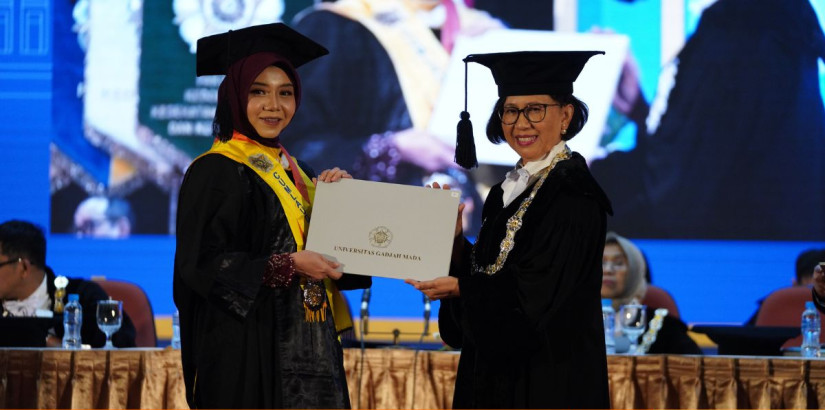
Rieska Indah Astuti, a graduate of the Master of Science in Economics (MSIE) program, was named the best master’s graduate of the Faculty of Economics and Business at Universitas Gadjah Mada (FEB UGM) during UGM’s Graduate School Commencement Ceremony for Academic Year 2025/2026 Period IV on Wednesday (July 22). She was among the 24 master’s graduates who achieved a perfect GPA of 4.00 and graduated with honors. In addition to earning the highest GPA, she completed her studies in just one year, nine months, and 27 days.
For Rieska, graduating with the highest academic distinction was the result of her courage to step outside her comfort zone after spending years building her career. It also proved that age and demanding responsibilities are not barriers to lifelong learning. Before pursuing her master’s degree, Rieska had spent 13 years working at Bank Indonesia (BI), where she was involved in policy analysis and formulation. Interestingly, her undergraduate degree was in mathematics rather than economics, a background that continues to shape the way she approaches economic issues today.
“I had 13 years of professional experience, but I realized that experience alone was not enough. I needed a strong academic foundation so that the decisions I make are based not only on experience, but also on theory, methodology, and empirical evidence,” she said on Thursday (July 23).

Her decision to pursue graduate studies did not come without careful consideration. Rieska initially faced a dilemma between continuing her education abroad or in Indonesia. She had been admitted to Nanyang Technological University (NTU) and had advanced to the final interview stage at the National University of Singapore (NUS), both of which are among Asia’s leading universities.
Ultimately, Rieska chose FEB UGM, not because she lacked other options, but because she believed its academic environment best matched what she truly needed: a balance between integrating professional experience with a solid academic foundation while keeping her family as a priority.
“I wanted this new chapter to bridge my professional experience with academic knowledge so that I can understand not only what happens, but also why it happens and how we should respond,” she explained.
Rieska’s interest in her thesis topic emerged even before she officially began her master’s studies. Her research examined the role of Indonesia’s state-owned banks in maintaining lending to micro, small, and medium enterprises (MSMEs) during periods of economic stress.
Her study highlighted the role of the Allowance for Impairment Losses (CKPN) in helping state-owned banks maintain their intermediary function during times of crisis. The topic stemmed from her observations during the COVID-19 pandemic, when MSMEs, the backbone of Indonesia’s economy, became the sector most severely affected by the economic downturn.
“MSMEs are the backbone of Indonesia’s economy, yet during periods of economic pressure they suffered the most. One reason is that banks tend to become much more cautious during a crisis, limiting financing to MSMEs to reduce risk, even though these businesses need financing the most,” she said.
Rieska explained that state-owned banks differ from private and foreign banks because they carry not only commercial objectives but also a social and development mandate. This mandate includes supporting vulnerable sectors such as MSMEs.
“I wanted to examine whether state-owned banks could continue fulfilling their social mandate during a crisis while maintaining prudent banking practices. Extending financing to vulnerable sectors like MSMEs during difficult times certainly carries risks, including higher non-performing loans,” she explained.
Her findings showed that state-owned banks continued to fulfill their social mandate by maintaining lending to MSMEs throughout the COVID-19 pandemic. This differed from private banks, which generally reduced lending during the same period.
The study also found that the availability of loan loss reserves (CKPN) influenced banks’ confidence in extending credit during periods of economic uncertainty. Banks with stronger reserves were generally more confident in continuing to provide financing during the crisis.
However, the impact of CKPN was not uniform across all banks. It varied depending on each institution’s capital strength, liquidity, funding capacity, and credit risk. Rieska believes this finding is important for policymakers, as it demonstrates that a one-size-fits-all approach should not be applied to all banks.

Throughout the thesis-writing process, Rieska was supervised by Dr. Eny Sulistiyaningrum. Initially, she assumed writing her thesis would be relatively easy because of her extensive research experience at Bank Indonesia. However, that perception changed throughout the supervision process.
“My supervisor taught me a valuable lesson. Research is not about defending personal opinions. I learned the importance of humility, being willing to refine my arguments based on data and constructive feedback,” she said.
During her studies at FEB UGM, Rieska found three things that she believes are difficult to find elsewhere: family, balance, and happiness. The supportive environment created by lecturers, academic staff, and fellow students became one of the main reasons she has never regretted choosing FEB UGM.
“The lecturers are inspiring and open to discussion, the academic staff are responsive and genuinely helpful, and my fellow students have always supported one another despite our significant age differences. I never felt any distance between us,” she said.
While balancing multiple roles at once, Rieska has always held on to one guiding principle, especially when studying alongside classmates who were much younger and brought fresh perspectives.
“Dream big, learn forever, and grow beyond limits. We must dare to dream bigger, continue learning throughout our lives, and grow beyond the limits we once believed we had.”
According to Rieska, that principle answered the doubts she had at the beginning of her journey: that returning to school after years of building a career is another form of courage and an opportunity for continuous growth.
Reporter: Dwi Zhafirah Meiliani and Kurnia Ekaptiningrum / FEB Public Relations
Editor: Gusti Grehenson
Post-Editor: Priyanandaningrat
Photo: FEB Public Relations