


Malnutrition and stunting remain major public health challenges in many countries, including Indonesia. Optimal exclusive breastfeeding is widely recognized as an important intervention for supporting healthy child growth and reducing the risk of stunting. However, insufficient breast milk production remains a concern for many postpartum mothers, highlighting the need for approaches that can support successful breastfeeding.
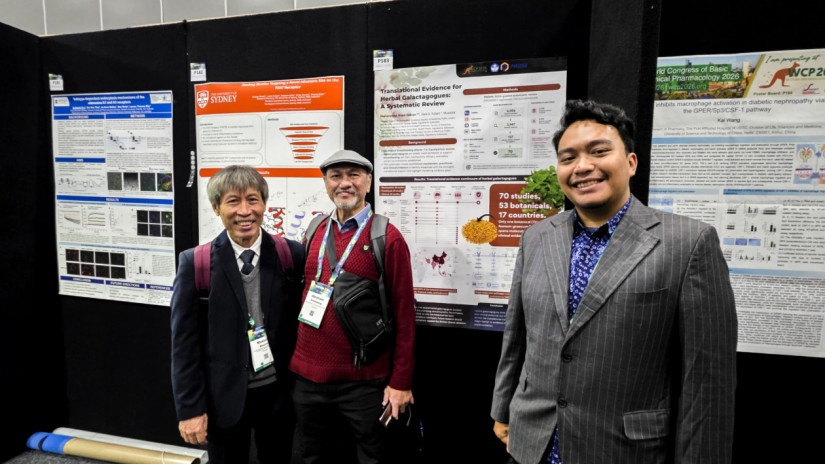
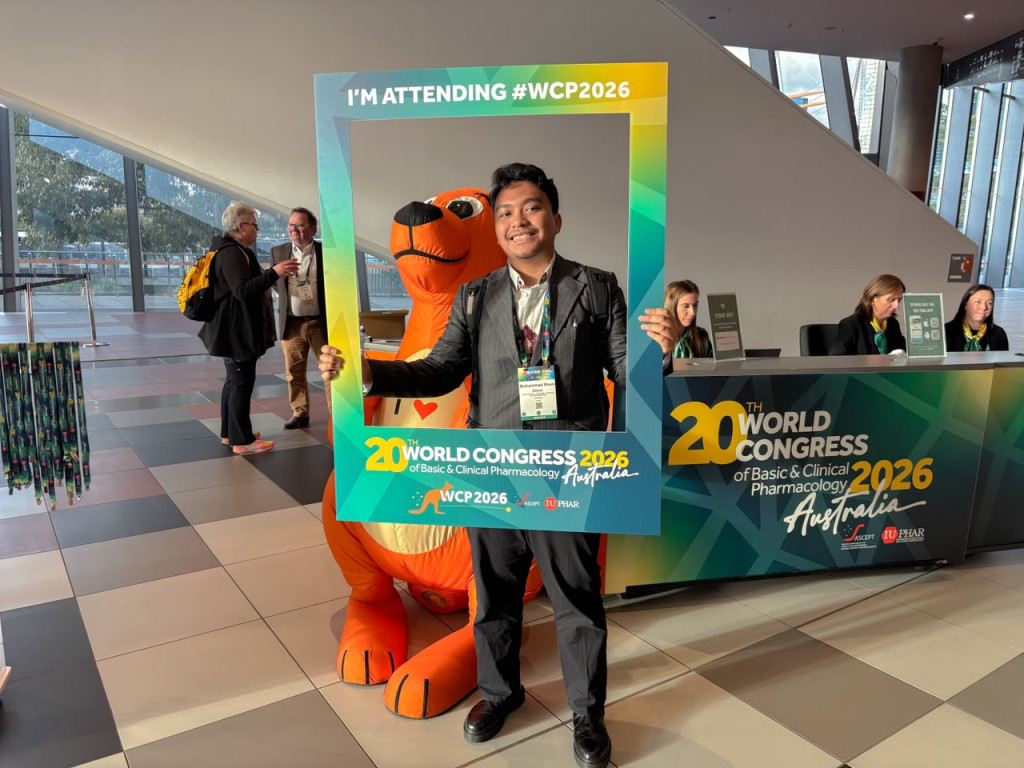
This issue has also attracted growing attention from the international scientific community. Muhammad Ilham Gibran, a fast-track student in the Master’s Program in Biomedical Sciences and the Doctoral Program in Medicine and Health Sciences at the Faculty of Medicine, Public Health, and Nursing, Universitas Gadjah Mada (FK-KMK UGM), presented his research at the 20th World Congress of Basic and Clinical Pharmacology (WCP2026) in Melbourne, Australia, held from July 12–17, 2026.
Held every three to four years, WCP is one of the leading international forums in pharmacology. The congress brings together researchers, clinicians, regulators, educators, and representatives of the pharmaceutical industry to exchange the latest findings in drug discovery, pharmacology, and evidence-based therapies.
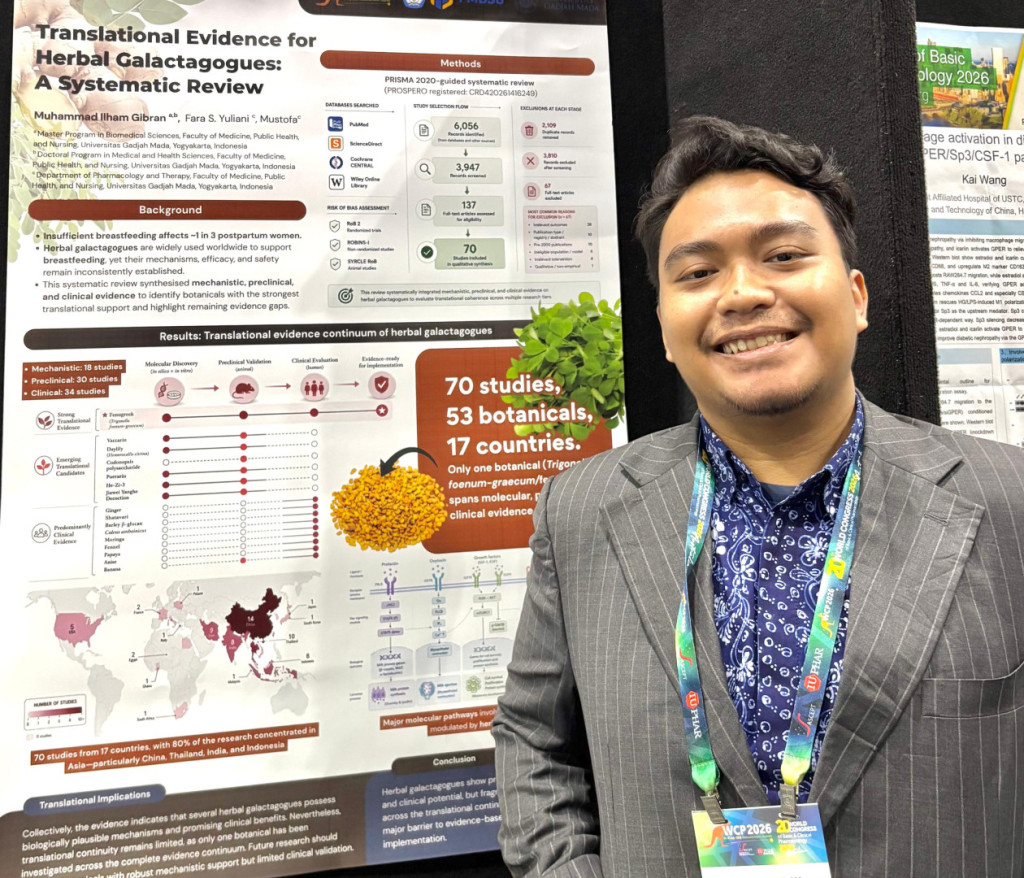
Under the supervision of Professor Mustofa and Dr. Fara Silvia Yuliani, Gibran presented a systematic review entitled “Translational Evidence for Herbal Galactagogues: A Systematic Review.” The study was accepted as a poster presentation under the Drug Discovery – Basic and Translational theme.
The research examines herbal galactagogues—plants traditionally used to support or increase breast milk production—and evaluates the scientific evidence surrounding their use in different countries.
According to Gibran, the use of medicinal plants to support breastfeeding has been passed down through generations in many cultures, including Indonesia. However, their reported benefits and safety are not always supported by the same level of scientific evidence.
“This study aims to provide a comprehensive overview of the available scientific evidence so that it can serve as a reference for researchers, healthcare professionals, and policymakers in developing evidence-based interventions,” Gibran said on Monday (July 27) at the UGM campus.
By synthesizing findings from dozens of studies conducted in multiple countries, the systematic review identifies herbal plants supported by stronger scientific evidence while also highlighting gaps that require further research.
Gibran explained that this approach is important because it helps bridge basic laboratory research and its potential application in healthcare practice—a process known as translational research.
“The development of herbal medicines should be based not only on empirical experience but also on sound and accountable scientific evidence,” he said.
The research is particularly relevant to Indonesia, which is home to one of the world’s richest sources of biodiversity and a wide variety of medicinal plants traditionally used to support maternal health.
However, Gibran emphasized that Indonesia’s biological resources alone are not enough to turn traditional knowledge into scientifically supported healthcare solutions. Research must also meet rigorous scientific standards and generate reliable evidence on effectiveness and safety.
“Presenting UGM students’ research at a global forum is one way to introduce this potential while also obtaining valuable feedback from the international scientific community,” he explained.
For Gibran, the opportunity to present at WCP2026 therefore extended beyond showcasing a research project. It also provided an opportunity to place research on Indonesia’s natural products within a broader international scientific discussion.
WCP2026 also provided a platform for collaboration among researchers, clinicians, regulators, and pharmaceutical industry representatives working to develop safer, more effective, and evidence-based therapies.
Over the six-day congress, participants attended scientific presentations, symposiums, panel discussions, and networking sessions covering a broad range of topics, including drug discovery, clinical pharmacology, toxicology, and the application of artificial intelligence in drug development.
Gibran said participation in international scientific forums is particularly valuable for young researchers because it provides opportunities not only to present their work but also to exchange ideas and build networks for future collaboration.
He hopes these connections will contribute to the continued development of research on Indonesia’s natural products and their potential applications in maternal and child health.
“We hope research on Indonesia’s natural products will continue to advance and make meaningful contributions to improving maternal and child health through evidence-based approaches,” he said.
Gibran’s participation in WCP2026 demonstrates how research conducted by UGM students can contribute to international scientific discussions on public health and natural product development.
As global interest continues to grow in natural product-based therapies and evidence-based approaches to maternal and child health, such international engagement also creates opportunities for Indonesian researchers to share local knowledge, strengthen scientific networks, and develop research with broader impact.
Author: Jelita Agustine
Editor: Gusti Grehenson
Post-Editor: Jasmine Ferdian
Photo: Courtesy of Gibran